

Medically reviewed by
USA Hemorrhoid Centers Medical Review Team
Reviewed October 2026
Hemorrhoids can develop at any age, including in your 20s and 30s. The condition affects people across the full age spectrum, though some groups face higher risk based on a combination of lifestyle habits, physical changes, and life events like pregnancy. Knowing where you fall on that spectrum can help you recognize symptoms earlier and make informed decisions about care.
We will cover which age groups see the highest rates of hemorrhoidal disease, why lifestyle matters more than a birth year, the first signs worth paying attention to, and when it may be time to speak with a hemorrhoid specialist to have a better understanding.
What Are Hemorrhoids?
Hemorrhoids are clusters of vascular tissue, smooth muscle, and connective tissue located in the anal canal and lower rectum. Everyone has this tissue; the condition known as hemorrhoidal disease occurs when those blood vessels swell, become irritated, or prolapse outside the anal opening.
There are two types. Internal hemorrhoids form inside the rectum and are typically painless, though they can cause rectal bleeding and, in more advanced cases, prolapse. The focus at USA Hemorrhoid Centers is specifically on internal hemorrhoids. External hemorrhoids develop under the skin around the anus and are outside the scope of the treatments offered here.
Symptoms of internal hemorrhoid symptoms can include:
- Bright red bleeding during or after bowel movements
- A sense of fullness or pressure in the rectal area
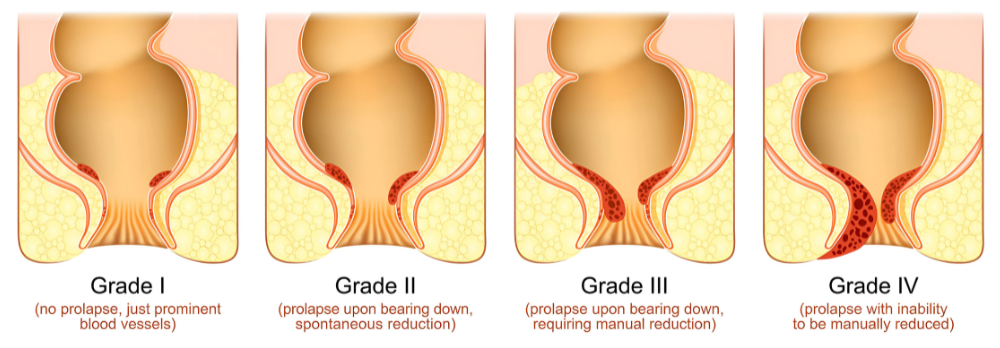
- Tissue that prolapses during straining and may require manual repositioning
- Itching or irritation around the anus
Hemorrhoid Development by Age Group: Who Is Most at Risk?
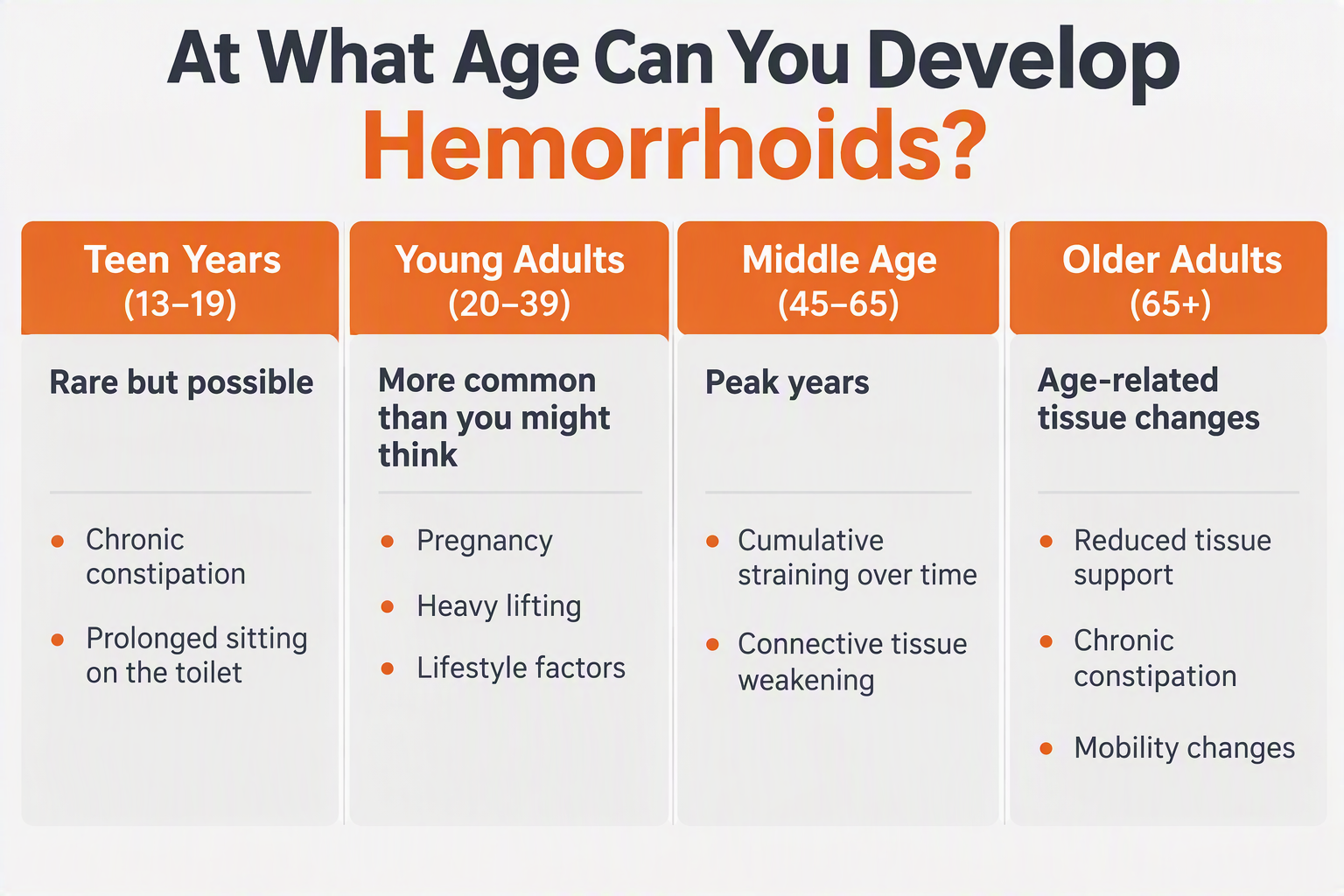
Hemorrhoids are among the most common anorectal conditions, and their prevalence changes across different stages of life.
Young Adults (20s-30s): More Common Than You Might Think
A widespread misconception holds that hemorrhoids are an older-person’s condition. Clinical data does not support that view. Research published in Scientific Reports found measurable hemorrhoidal disease across adults of all ages, with lifestyle behaviors identified as the leading contributing factors regardless of age.[1] A 2020 review in Clinics in Colon and Rectal Surgery noted that while prevalence peaks between ages 45 and 65, hemorrhoids are far from rare in younger populations.[2]
Young adults are not immune to the core drivers of hemorrhoid development: low-fiber diets, chronic constipation, prolonged sitting, extended time on the toilet, and pregnancy. College students and professionals who sit for most of their working day, eat convenience foods, and stay sedentary are at real risk.
Middle-Aged Adults (45-65): The Peak Years
Research consistently identifies this age range as the period when hemorrhoidal disease is most common. As the body ages, the connective tissue that holds hemorrhoidal cushions in place begins to weaken. This structural change makes the tissue more susceptible to swelling and prolapse even without the straining or lifestyle factors that drive younger-adult cases.[3]
Risk compounds during this stage for a number of reasons: constipation becomes more common, physical activity often decreases, and the cumulative effect of years of straining or poor dietary habits adds up. Understanding hemorrhoid grades and stages becomes particularly relevant for adults in this age group, as symptoms tend to progress if contributing factors are not addressed.
Older Adults (65+): Age-Related Tissue Changes
For adults over 65, weakened supporting tissue and reduced mobility are the primary contributors. Chronic constipation becomes more prevalent, circulation slows, and the physical resilience of rectal tissue decreases with age. The same core approaches to management apply, and the availability of minimally invasive treatment means that age alone is not a barrier to evaluation or care.
Why Age Is Only Part of the Story for Developing Hemorrhoids
The most consistent finding across research on hemorrhoids is that risk is driven more by what you do than how old you are. Several modifiable factors raise hemorrhoid risk across all age groups:
- Straining during bowel movements – the single most well-documented driver, typically linked to constipation and low fiber intake
- Prolonged sitting – including long hours at a desk or extended toilet time, which increases rectal venous pressure
- Low-fiber diet – the average American consumes roughly half the recommended 25-30 grams of fiber daily, producing harder stools that require more effort to pass[2]
- Pregnancy – elevated abdominal pressure, increased blood volume, and hormonal changes that relax vein walls create a significant risk window for younger women
- Heavy lifting – particularly with improper breathing technique, which raises intra-abdominal pressure
- Family history – a hereditary component is recognized; some individuals have connective tissue that is structurally more susceptible
Understanding what causes hemorrhoids at a biological level can help clarify whether your current habits may be contributing to symptoms.
Early Warning Signs of Developed Hemorrhoids
Hemorrhoids are often silent in the early grades. The signs that do appear are worth paying attention to, particularly because earlier-stage hemorrhoids respond to a wider range of treatment approaches.
Common early signs include:
- Bright red blood on toilet paper or in the bowl after a bowel movement
- A feeling of incomplete emptying after a bowel movement
- Mild rectal itching or irritation
- A soft lump or sensation of tissue near the anal opening
One important note: rectal bleeding can be a sign of other conditions, including anal fissures and, more rarely, colorectal disease. A specialist evaluation is the right step whenever bleeding is present, to confirm the source and rule out other diagnoses. Relying on self-diagnosis based on symptoms alone is not recommended.
When to See a Hemorrhoid Specialist
Symptoms that warrant a professional evaluation include:
- Rectal bleeding that recurs or does not resolve within one to two weeks
- Prolapse that cannot be manually repositioned
- Significant pain, swelling, or feeling of pressure
- Symptoms that interfere with daily activities or sleep
- Hemorrhoids that recur frequently despite lifestyle changes
What happens when hemorrhoids are left untreated is well-documented: early-grade conditions can progress over time, and advanced-grade hemorrhoids carry a higher risk of complications including thrombosis, tissue damage, and anemia from chronic bleeding.
Can USA Hemorrhoid Centers Help?
USA Hemorrhoid Centers offers hemorrhoid artery embolization (HAE), a minimally invasive, image-guided procedure performed by experienced interventional radiologists on an outpatient basis. HAE works by reducing blood flow to the hemorrhoidal tissue, causing it to shrink without surgery, cutting, or general anesthesia. Most patients return to normal activities quickly.
HAE is appropriate for Grade 2 and Grade 3 internal hemorrhoids. A consultation with a specialist is the first step to determining whether you are a candidate, regardless of your age.
Treatment Option: HAE
Hemorrhoids Are Treatable at Any Age
Symptoms like bleeding, prolapse, and rectal pressure are not something you have to manage indefinitely. Knowing that hemorrhoids can develop at any stage of life is the first step. Taking action to get evaluated is the next one.
USA Hemorrhoid Centers offers minimally invasive, outpatient treatment performed by experienced interventional radiologists. Procedures are completed in the office, typically in under an hour, with no general anesthesia required and a rapid return to daily activities for most patients. The first step is a consultation to evaluate your symptoms and discuss the options that fit your situation.
FAQs About Hemorrhoid Development
- Kim SY, et al. “Risk factors for hemorrhoidal disease among healthy young and middle-aged Korean adults.” Scientific Reports. January 7, 2022. https://www.nature.com/articles/s41598-021-03838-z
- Lohsiriwat V. “Hemorrhoids: From basic pathophysiology to clinical management.” World Journal of Gastroenterology. 2012;18(17):2009-2017. https://www.ncbi.nlm.nih.gov/pmc/articles/PMC3342598/
- News-Medical. “Epidemiology of Hemorrhoids.” December 29, 2022. https://www.news-medical.net/health/Epidemiology-of-Hemorrhoids.aspx
Medical disclaimer: USA Hemorrhoid Centers content provides medical education only. It is not a diagnosis or treatment recommendation. Consult a hemorrhoid specialist for evaluation.