
Medically reviewed by
USA Hemorrhoid Centers Medical Review Team
Hemorrhoid artery embolization (HAE) is a non-surgical treatment for internal hemorrhoids. It reduces blood flow to swollen hemorrhoidal tissue, which allows the tissue to shrink and helps painful symptoms ease over time.
During the procedure, an interventional radiologist guides a thin catheter through a small entry point in the wrist or groin to the arteries that feed the hemorrhoids. Once in place, the doctor releases tiny particles or coils to block blood flow, without any cutting, stitches, or rectal packing.
Our medical team and staff is committed to ensuring patients understand how HAE works, which hemorrhoid grades it treats, and what research shows about outcomes. We also cover what recovery looks like and how to know if this hemorrhoid treatment option may fit your needs and help you find relief.
Quick facts
- Condition Treated: HAE is used mainly for Grade 1 through Grade 3 symptomatic internal hemorrhoids1
- Outpatient Setting: The procedure typically takes about 45 minutes, requires no hospital stay, and uses local numbing with light sedation
- Targeted Blood Supply: Treatment works through blood vessels from the wrist or groin without creating cuts or open wounds in the rectal canal
- Proven Symptom Relief: A 2023 peer-reviewed study in the Journal of Vascular and Interventional Radiology found 93 percent of patients improved within one month3
- High Success Rates: Published clinical research reports overall success rates ranging as high as 97 percent4
- Rapid Daily Recovery: Most patients return to work and light everyday routines within one to two days
What Is Hemorrhoid Artery Embolization?
Hemorrhoid artery embolization treats internal hemorrhoids in a different way than most office-based options. Instead of working directly on the hemorrhoid tissue, HAE targets the blood vessels that feed it.
Internal hemorrhoids form from a dense network of blood vessels just above the anal canal. When blood flow and pressure in these vessels stay high, they can stretch, swell, and bleed. By blocking the arteries that feed this tissue, HAE lowers the pressure inside the vessels. Over time, this helps the tissue shrink and eases bleeding and prolapse.
Because the doctor reaches the arteries through the wrist or the upper thigh, the anal canal itself is never touched. This means no rectal wounds form, and the risk to normal muscle function and bowel control stays very low.
How Hemorrhoid Embolization Works
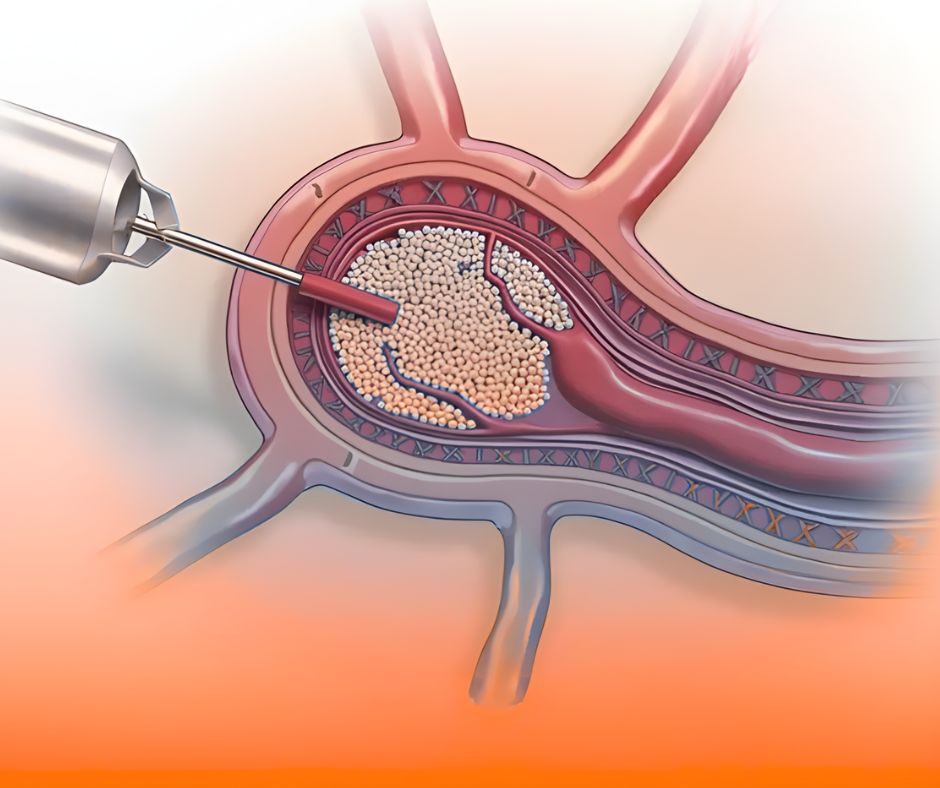
Hemorrhoid artery embolization is an image-guided procedure that reduces blood flow to hemorrhoidal tissue. Learn more about how hemorrhoid artery embolization works and how blocking blood flow leads to lasting tissue shrinkage.
The procedure relies on fluoroscopy, a type of real-time X-ray imaging. This lets our experienced interventional radiologists guide small tools through the blood vessels with precision. Here is how HAE is performed, step by step.
- Accessing the Artery: After numbing the area with local anesthesia and giving you mild sedation, your doctor makes a small puncture in the wrist or groin to reach a blood vessel.
- Guiding the Catheter: Using live imaging, the doctor guides a thin catheter through the blood vessels toward the arteries that feed the hemorrhoids. This imaging helps find the exact branches that need treatment.
- Embolizing the Artery: Once the right arteries are found, the doctor injects tiny particles or places small coils. These block blood flow to the hemorrhoidal tissue, while normal blood flow to the rest of the rectal wall continues.
- Recovery: The catheter is removed and gentle pressure is applied to the puncture site. No stitches are needed. You rest briefly in our recovery area before going home the same day.
Hemorrhoid Artery Embolization Procedure: What to Expect
Knowing what happens before, during, and after treatment can help ease any worry. Here is what to expect at each step of your HAE visit.
Initial Consultation
Your visit starts with a consultation. Your interventional radiologist will ask about your symptoms, how long you have had them, and any treatments you have already tried. This visit also confirms your hemorrhoid grade and rules out other conditions that could cause similar symptoms.
Your doctor will also review your complete medication list, check for underlying issues such as anemia from bleeding, and explain how the procedure compares with other options so you can choose the best approach with confidence.
The Day of the Procedure
Bring someone with you to drive you home, and wear loose, comfortable clothing. Once you are settled in our treatment room, you will receive mild sedation through an IV line to help you stay comfortable and relaxed. The embolization itself takes about 45 minutes. In total, plan to be at our office for around two hours.
Recovery After Hemorrhoid Artery Embolization
After treatment, you will rest in our recovery room for about an hour while our team checks on you. Unlike surgery, HAE does not cause pain or burning during bowel movements afterward.
Some patients notice mild soreness or a dull ache for two to three days, which usually responds well to over-the-counter pain relief. We recommend avoiding heavy lifting or hard exercise for three to five days. Most people return to work and daily routines within a day or two.
Why Is HAE Performed?
Doctors may recommend HAE when bleeding, prolapse, or pelvic discomfort do not improve with a high-fiber diet, more water, or less straining. HAE aims to treat the source of the problem by reducing blood flow to the hemorrhoidal tissue, rather than only easing symptoms for a short time.
HAE can also be a good option for patients who face higher risk with more invasive procedures. This includes people taking blood thinners or those with other health concerns.
Benefits of the Hemorrhoid Embolization Procedure
Hemorrhoidal artery embolization offers several advantages over other hemorrhoid treatment options. At USA Hemorrhoid Centers, our specialists recommend HAE for the following reasons:
- Keeps the hemorrhoidal tissue in place
- Preserves anal continence
- Does not involve rectal wounds or incisions
- Typically completed in about 45 minutes, on an outpatient basis
- Uses local anesthesia and mild sedation, not general anesthesia
- Generally lower reported pain than surgical approaches
- Short recovery time with no hospital stay
What Type of Hemorrhoids Does HAE Treat?
HAE treats internal hemorrhoids, most often those classified as Grade 1 through 3 on the standard grading scale.1 This scale describes how much the tissue has prolapsed outside the anal canal. Learn more about how internal hemorrhoids are graded from Stage 1 to Stage 4 to see where your symptoms may fall.
| Hemorrhoid Grade | What It Looks Like | HAE Candidacy |
|---|---|---|
| Grade 1 | Bleeds during bowel movements but does not prolapse outside the anal canal. | Often a good candidate, especially with ongoing bleeding |
| Grade 2 | Prolapses during straining but returns inside on its own. | Often a good candidate |
| Grade 3 | Prolapses and must be pushed back in by hand. | May be a candidate, based on evaluation |
| Grade 4 | Permanently prolapsed and cannot be pushed back in. | Evaluated case by case |
Bleeding as a Primary Indication
Ongoing or repeat rectal bleeding is one of the most common reasons patients choose HAE. Over time, blood loss from internal hemorrhoids can sometimes lead to iron deficiency anemia.2 If hemorrhoid symptoms go untreated, they can slowly get worse and become harder to manage.
Candidacy Depends on Individual Evaluation
HAE treats internal hemorrhoids and is not used for external hemorrhoids or skin tags, which need a different approach. A specialist examines you to confirm the type and grade of hemorrhoid before recommending HAE or any other option. Learn more about hemorrhoid removal without surgery to see how non-surgical options compare.
Hemorrhoid Treatment Comparisons
| Treatment Parameter | HAE (Embolization) | Rubber Band Ligation | Surgical Hemorrhoidectomy |
|---|---|---|---|
| Access Point | Vascular (Wrist or Groin) | Internal Rectal Canal | Direct Perianal Incisions |
| Rectal Incisions or Wounds | None | Localized tissue sloughing | Open or sutured wounds |
| Anesthesia Type | Local numbing with light sedation | None or topical gel | General or spinal anesthesia |
| Expected Recovery Window | 1 to 2 days | 2 to 3 days per session | 2 to 4 weeks with substantial pain |
| Risk to Sphincter Continence | Preserved | Rare risk | Documented surgical risk |
How HAE Differs From Other Internal Hemorrhoid Approaches
Many office-based hemorrhoid treatments work directly at the site of the hemorrhoid, inside the anal canal. HAE takes a different route. It works through the bloodstream instead, targeting the blood supply rather than the tissue itself. This can treat several hemorrhoids at once in a single session, without added instruments placed inside the rectum.
For patients who take blood thinners or have health conditions that increase surgical risks, this endovascular method offers an effective way to relieve symptoms without open incisions or the severe burning pain often linked with surgical tissue removal.
Can USA Hemorrhoid Centers Help?
USA Hemorrhoid Centers is a national network of outpatient clinics focused on non-surgical treatment for internal hemorrhoids. Our team of experienced interventional radiologists uses advanced imaging to guide each procedure with precision.
Every patient receives a full evaluation, including a review of your symptoms, medical history, and hemorrhoid grade, before we recommend a treatment plan built around your needs. Our team stays with you from your first visit through your follow-up care.
If hemorrhoid bleeding or discomfort is affecting your daily life, schedule a consultation at a center near you. Call 855-805-4247 or book online.
Book Online 24/7What Does the Research Show About Hemorrhoid Artery Embolization Outcomes?
A study in the Journal of Vascular and Interventional Radiology followed 134 patients who had HAE for internal hemorrhoids. Doctors treated at least one hemorrhoidal artery in 99 percent of patients. At the one-month follow-up, 93 percent of patients showed clinical improvement.3 The study also found better symptom scores, pain scores, and quality of life scores, with no severe side effects reported.
Looking across published research more broadly, reported clinical success rates for HAE range as high as 97 percent, though results vary depending on the study and how success is measured.4
| Outcome | Reported Finding | Source |
|---|---|---|
| Technical success | 99% of patients had at least one artery successfully treated | Bagla et al., 2023, JVIR |
| Clinical improvement at 1 month | 93% of patients improved | Bagla et al., 2023, JVIR |
| Success rate range across published literature | Reported as high as 97% | Rebonato et al., PMC review |
What the Data Means for Patients
These results suggest HAE can offer real symptom relief for many patients whose hemorrhoids have not responded to other care. A small number of patients may need a repeat embolization, most often because a second blood vessel feeding the hemorrhoids was not treated the first time. A specialist can help set realistic expectations based on your case.
Ready to Talk to a Hemorrhoid Specialist about Hemorrhoid Artery Embolization?
More fiber, more water, and less straining can reduce discomfort and help manage symptoms day to day. But if you are experiencing persistent bleeding, prolapse, pain during bowel movements, or ongoing itching and pressure, lifestyle adjustments alone are unlikely to resolve the problem.
USA Hemorrhoid Centers offers minimally invasive, outpatient treatment performed by experienced interventional radiologists. Procedures are completed in the office, typically in under an hour, with no general anesthesia required and a rapid return to daily activities for most patients. The first step is a consultation to evaluate your symptoms and discuss the options that fit your situation.
Frequently Asked Questions about HAE for Hemorrhoid Treatment
- Sun, Z., & Migaly, J. (2016). Review of Hemorrhoid Disease: Presentation and Management. Clinics in Colon and Rectal Surgery, 29(1), 22-29.
- Abramowitz, L., et al. Hemorrhoids in pregnancy. Canadian Family Physician / PMC.
- Bagla, S., Pavidapha, A., Lerner, J., et al. (2023). Outcomes of Hemorrhoidal Artery Embolization from a Multidisciplinary Outpatient Interventional Center. Journal of Vascular and Interventional Radiology, 34(5), 745-749.
- Rebonato, A., et al. Hemorrhoids Embolization: State of the Art and Future Directions. PMC.
Medical disclaimer: This content is for informational purposes only and is not a substitute for professional medical advice, diagnosis, or treatment. Always seek the guidance of a qualified healthcare provider with any questions you may have regarding a medical condition.
Sources
- Bagla, Sandeep, MD, et al. Outcomes of Hemorrhoidal Artery Embolization from a Multidisciplinary Outpatient Interventional Center. Journal of Vascular and Interventional Radiology. Volume 34, ISSUE 5, P745-749, May 2023
- Ricci, M. P., Matos, D., & Saad, S. S. (2008). Rubber band ligation and infrared photocoagulation for the outpatient treatment of hemorrhoidal disease. Acta cirurgica brasileira, 23(1), 102–106.
- Sun, Z., & Migaly, J. (2016). Review of Hemorrhoid Disease: Presentation and Management. Clinics in colon and rectal surgery, 29(1), 22–29.
- Lisi, G., Gentileschi, P., Spoletini, D., Passaro, U., Orlandi, S., & Campanelli, M. (2022). Sclerotherapy for III- and IV-degree hemorrhoids: Results of a prospective study. Frontiers in surgery, 9, 978574.
- Rebonato, A., Maiettini, D., Patriti, A., Giurazza, F., Tipaldi, M. A., Piacentino, F., Fontana, F., Basile, A., & Venturini, M. (2021). Hemorrhoids Embolization: State of the Art and Future Directions. Journal of clinical medicine, 10(16), 3537.
Dr. Pridjian and his staff were extremely knowledgeable, professional, friendly, patient, and put me at ease as I was very nervous. The procedure went exactly it had been explained to me. I would highly recommend Dr. Pridjian and his team!
Dr. Reichman did his job competently and professionally. He is a credit to his profession. His assistant, nurse Kenya was professional, courteous, comforting, and definitely competent during the procedure. They are lucky to have her on their team.
Very helpful staff who made me feel comfortable. The provider was fantastic and I’m actually looking forward to my procedure. 🤞🏻
Dr. Reichman is the best! I’m super glad I decided to get my procedure with him.
Ease access, friendly staff and excellent doctor! I totally recommend!
Doctor Reichman is Fantastic!! Made me feel totally comfortable and at ease with procedure. Now I have no more symptoms!! Free after 20 years of discomfort.
Highly recommended! They made my whole process from original consultation to procedure a great experience!
Just unbelievable! All the staff taking care of you - every human person there - made the experience was mind blowing. Thank you to everyone! Very amazing experience at USA Hemorrhoid Centers!
Excellent place and the service is top notch!
USA Hemorrhoid Centers tool very good care of my needs! From beginning to the end very professional - would recommend any time.
The staff was welcoming, professional, and made me feel comfortable from the moment I walked in. The provider took the time to explain everything clearly and answered all my questions. The procedure was smooth and efficient, and overall I felt very well taken care of. Highly recommend!
I would recommended anyone needing instant relief of hemorrhoids! GREAT doctors and true professionals!
I highly recommend this place to anyone. Everyone was super friendly and professional and made my whole experience better than I could have expected. If you need a Hemorrhoid Artery Embolization, I highly recommend.
That’s a good place to receive better treatment of Hemorrhoids. You will get a good care of what you are looking for. Dr. Aaron D. Reichman is an amazing person.
Everything done professionally and the staff was super friendly and attentive!
USA Hemorrhoid Centers was very friendly and professional. Getting appointments, making any adjustments, and check in was very easy. My HAE procedure was delayed due to a snow storm. Althought it was an inconvenience, the office reached out to me and did everything possible to reschedule and assist me. I was able to get my procedure done the next day! Dr. Reichman is an excellent doctor. Friendly, knowledgeable, and very experienced in hemorrhoid artery embolization. I felt comfortable the whole time, from consultation to post-procedure. Couldn't have had a better experience.
It was a very good experience from the attention with the nurses and the doctor!
The doctor was great. Very good experience. My procedure was a success, they are very pleasant, helpful and respectful to me and my husband.
The doctor and staff are wonderful. it was my first procedure ever and they made me very comfortable with explaining the procedure step by step. Also, his assistant was very nice. She took very good care of me and I appreciate her so much! 10/10 recommend.
The staff was very helpful and professional. The doctor explained the procedures and he helped me make the best decision.
The doctor was wonderful. He explained all symptoms and detailed the procedure. After receiving my treatment, I feel much much better! USA Hemorrhoid Centers, Dr. H and his staff are excellent!!!!
I recently underwent a nonsurgical procedure that provided better results than the surgeries I already had to address the issues. Dr. Taghipour expertly walked me through each step and patiently answered all my questions. The procedure was comfortable with minimal downtime, and I noticed positive results quickly. The office was modern and clean, while the nurses provided attentive, personalized care. I highly recommend this nonsurgical option and Dr. Taghipour’s practice to anyone with similar concerns.
Great experience!!! This is the place to go to if you are dealing with hemorrhoids issues!

The staff was very helpful and professional. The doctor explained the procedures and he helped me make the best decision.

Dr G and whole staff are incredible. My hemorrhoid procedure was completely painless and effective
 Ivan G.
They explained everything I needed to know about the HAE procedure in a very easy-to-get way, by the time of the procedure, I had no fear or doubt that I was on the right place.
 Abe K.
I am so glad to have gone to USA Hemorrhoid Centers. My experience has been amazing. The staff are all so friendly but professional. The doctor is wonderful and in his professional manner makes you very comfortable and explains anything you have questions about. So very happy.

USA Hemorrhoid Centers all staff were incredible. They communicated throughout and checked in frequently to ensure I was as comfortable as possible. I am happy I chose to get the treatments and look forward to the improvements.