

Medically reviewed by
USA Hemorrhoid Centers Medical Review Team
Experienced interventional radiology specialists
Reviewed: August 2026
Internal hemorrhoids sometimes go away on their own, but whether they do largely depends on their grade, how long they have been present, and whether the habits that contributed to them are addressed. Grade 1 hemorrhoids may resolve with dietary and lifestyle adjustments. Higher-grade hemorrhoids are significantly less likely to self-resolve and may worsen over time without evaluation.
We will cover how grade affects self-resolution, what conservative measures can do, when symptoms signal a need for specialist care, and what treatment options exist for internal hemorrhoids that do not go away.
Can Internal Hemorrhoids Resolve Without Treatment?
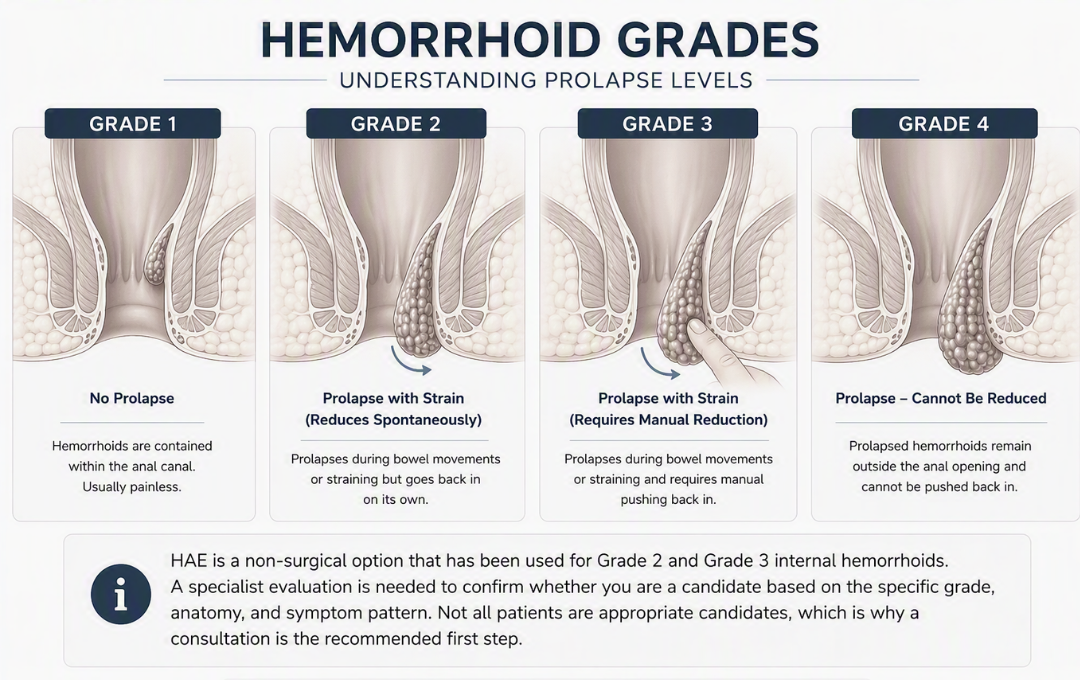
Internal hemorrhoids develop when the vascular cushions inside the rectum become swollen and irritated. Whether they resolve without treatment depends primarily on their grade. Doctors classify internal hemorrhoids on a scale of 1 through 3 based on how far they prolapse – the term for tissue slipping beyond its normal position in the anal canal. Understanding your hemorrhoid grades and stages can help set realistic expectations about what conservative care is likely to accomplish.
Grade 1 and 2 hemorrhoids have a reasonable chance of improving with dietary and behavioral changes. Grade 3 hemorrhoids are less likely to resolve without medical evaluation, as they reflect a structural change in the supporting tissue rather than simple inflammation.
Grade 1 and Grade 2: When Self-Resolution Is Possible
Grade 1 internal hemorrhoids do not protrude outside the anal canal. They are the earliest stage and most likely to improve with consistent lifestyle changes. Adding fiber (typically 25-38 grams per day for adults), increasing water intake, reducing straining during bowel movements, and avoiding prolonged sitting on the toilet can all help reduce swelling in Grade 1 hemorrhoids. Many people see improvement within days to a week.
Grade 2 hemorrhoids prolapse during a bowel movement but return inside on their own. They may respond to the same conservative measures as Grade 1, though improvement tends to be slower and recurrence is more common. If Grade 2 symptoms return repeatedly, a specialist evaluation can help determine whether a longer-term approach is needed.
Conservative measures that may help both grades:
- Increasing dietary fiber gradually to soften stool
- Drinking adequate water throughout the day
- Using a sitz bath (warm water soak) for 10-15 minutes after bowel movements
- Avoiding straining and limiting time spent on the toilet
- Using over-the-counter topical products for short-term symptom relief
These steps address contributing factors and may reduce inflammation, but they do not alter the underlying vascular anatomy of the hemorrhoid.
Grade 3 Hemorrhoids: Why They Rarely Go Away on Their Own
Grade 3 internal hemorrhoids prolapse outside the anal opening during straining and require manual repositioning to return inside. At this stage, the supporting tissue around the hemorrhoid has stretched beyond the point where lifestyle changes alone typically produce lasting improvement. Conservative measures may reduce discomfort and bleeding, but they are unlikely to correct the prolapse itself.
Leaving Grade 3 hemorrhoids unaddressed for extended periods is associated with symptom progression. Prolapse can become more frequent, and repeated protrusion may lead to tissue irritation and a higher risk of bleeding episodes.
What Happens If Internal Hemorrhoids Are Left Untreated?
When hemorrhoids are left untreated, they may progress over time rather than stabilize or resolve. Grade 1 hemorrhoids may advance to Grade 2, and Grade 2 to Grade 3, particularly if underlying factors such as chronic constipation or straining are not modified. Persistent rectal bleeding, even in small amounts, can contribute to anemia over time. Prolapsed tissue that becomes trapped outside the anal canal may become acutely painful and require urgent evaluation.
While bright red blood from internal hemorrhoid symptoms is common and usually not immediately dangerous, any rectal bleeding should be evaluated by a clinician to confirm its source, since other conditions can produce similar symptoms. If hemorrhoid symptoms have not improved within one week of consistent conservative care, scheduling a consultation is the appropriate next step rather than continued observation.
When to See a Hemorrhoid Specialist To Help Hemorrhoids Go Away
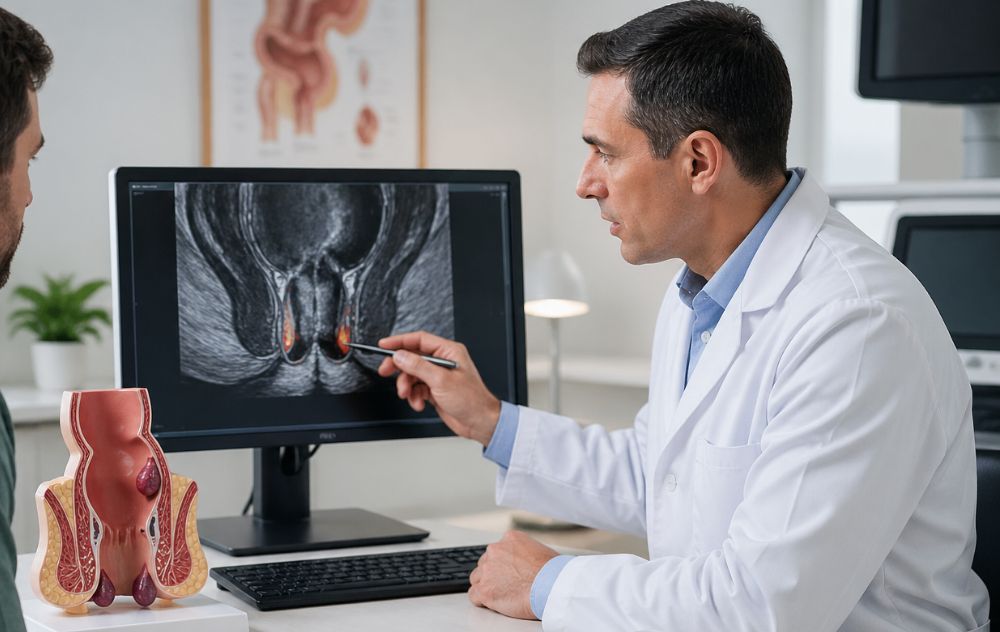
Certain patterns indicate that conservative management is unlikely to be sufficient and that a hemorrhoid specialist evaluation is warranted:
- Bleeding during or after bowel movements that recurs over several weeks
- Tissue that prolapses and does not return on its own
- Discomfort, pressure, or itching that interferes with daily activities
- Symptoms that return quickly after a period of improvement
- Any rectal bleeding in a patient over 45 or with a family history of colorectal conditions, which should always be evaluated
A hemorrhoid specialist can confirm the grade of your hemorrhoids through a physical examination and discuss what options are appropriate based on your specific anatomy and symptom pattern.
Meet Our DoctorsCan USA Hemorrhoid Centers Help?
For internal hemorrhoids that have not responded to conservative management, hemorrhoid artery embolization (HAE) is a minimally invasive, image-guided outpatient procedure that addresses the underlying blood flow contributing to hemorrhoid swelling. It is performed by experienced interventional radiologists and is an option for Grade 1 through Grade 3 internal hemorrhoids. Procedures are typically completed in under an hour, with no general anesthesia required and a rapid return to daily activities for most patients.
A consultation is the first step to determine whether HAE may be appropriate for your situation.
Treatment option: hemorrhoid treatment
Lifestyle Changes Can Help. But They Do Not Treat the Underlying Condition.
More fiber, more water, and less straining can reduce discomfort and help manage symptoms day to day. But if you are experiencing persistent bleeding, prolapse, pain during bowel movements, or ongoing itching and pressure, lifestyle adjustments alone are unlikely to resolve the problem. These are clinical symptoms that indicate the hemorrhoidal tissue has been significantly affected.
USA Hemorrhoid Centers offers minimally invasive, outpatient treatment performed by experienced specialists. Procedures are completed in the office, typically in under an hour, with no general anesthesia required and a rapid return to daily activities for most patients. The first step is a consultation to evaluate your symptoms and discuss the options that fit your situation.
Frequently Asked Questions
- Lohsiriwat V. “Hemorrhoids: From basic pathophysiology to clinical management.” World Journal of Gastroenterology. 2012;18(17):2009-17. https://pmc.ncbi.nlm.nih.gov/articles/PMC3342598/
- National Institute of Diabetes and Digestive and Kidney Diseases (NIDDK). “Treatment of Hemorrhoids.” U.S. Department of Health and Human Services. https://www.niddk.nih.gov/health-information/digestive-diseases/hemorrhoids/treatment
- Vidal V, et al. “Hemorrhoidal Embolization: A New Concept.” Cardiovascular and Interventional Radiology. 2015;38(3):72-80. https://pubmed.ncbi.nlm.nih.gov/25572110/
Medical disclaimer: USA Hemorrhoid Centers content provides medical education only. It is not a diagnosis or treatment recommendation. Consult a hemorrhoid specialist for evaluation.
Frequently Asked Questions
Prolapsed internal hemorrhoids originate inside the rectum and push outward during straining; the tissue is typically soft, moist, and a deep pink or red color. External hemorrhoids form outside the anal opening under the skin and tend to feel firmer. A clinician can confirm the type and grade through a physical examination, which is the reliable way to distinguish between them.
Internal hemorrhoids may progress over time, particularly when contributing factors such as chronic straining, low fiber intake, or prolonged sitting are not addressed. Grade 1 hemorrhoids can advance to Grade 2 or Grade 3 if left unmanaged. However, progression is not inevitable, and consistent lifestyle modifications may help slow or stabilize early-stage hemorrhoids.
Any grade of internal hemorrhoid that causes persistent bleeding, discomfort, or prolapse warrants evaluation. Grade 1 hemorrhoids that do not respond to conservative care after one to two weeks are worth discussing with a specialist. Grade 3 hemorrhoids, which require manual repositioning, are unlikely to resolve on their own and are typically candidates for a minimally invasive intervention.
Grade 1 hemorrhoids may improve within a few days to a week with conservative care. Higher-grade hemorrhoids may not fully resolve without medical intervention, and symptoms can recur if underlying habits are not modified. There is no fixed timeline, which is why seeking a specialist evaluation is appropriate when symptoms persist beyond one week.
Lifestyle changes – including increased fiber, adequate hydration, and avoiding straining – can help Grade 1 and some Grade 2 internal hemorrhoids improve or become less symptomatic. They are less likely to resolve Grade 3 hemorrhoids, where tissue has already prolapsed beyond the point of simple inflammation. Lifestyle changes remain an important part of management at every grade.
Bright red blood from internal hemorrhoids is common and often not immediately dangerous, but it should not be dismissed. Persistent or heavy bleeding can contribute to anemia. More importantly, rectal bleeding has multiple possible causes, and a clinician needs to confirm that hemorrhoids are the source. If you notice recurring blood in the stool or on toilet paper, an evaluation is appropriate.
Hemorrhoid artery embolization (HAE) is a minimally invasive, outpatient procedure in which an interventional radiologist uses image guidance to reduce blood flow to the hemorrhoidal tissue. By delivering tiny particles through a catheter, the procedure causes the hemorrhoid to shrink without cutting or removing tissue. It requires no general anesthesia and is an option for Grade 1 through Grade 3 internal hemorrhoids that have not responded to conservative care.
Yes. HAE is a non-surgical option that has been used for Grade 2 and Grade 3 internal hemorrhoids. A specialist evaluation is needed to confirm whether you are a candidate based on the specific grade, anatomy, and symptom pattern. Not all patients are appropriate candidates, which is why a consultation is the recommended first step. Learn more about internal hemorrhoid treatment options.
References:
- Sun, Z., & Migaly, J. (2016). Review of Hemorrhoid Disease: Presentation and Management. Clinics in colon and rectal surgery, 29(1), 22–29.
- Reza Talaie,, Pooya Torkian, et all. Hemorrhoid embolization: A review of current evidences. Diagnostic and Interventional Imaging. Volume 103, Issue 1, January 2022, Pages 3-11