
Medically reviewed by
Dr. Yan Katsnelson, Physician
USA Hemorrhoid Centers | Reviewed June 2026
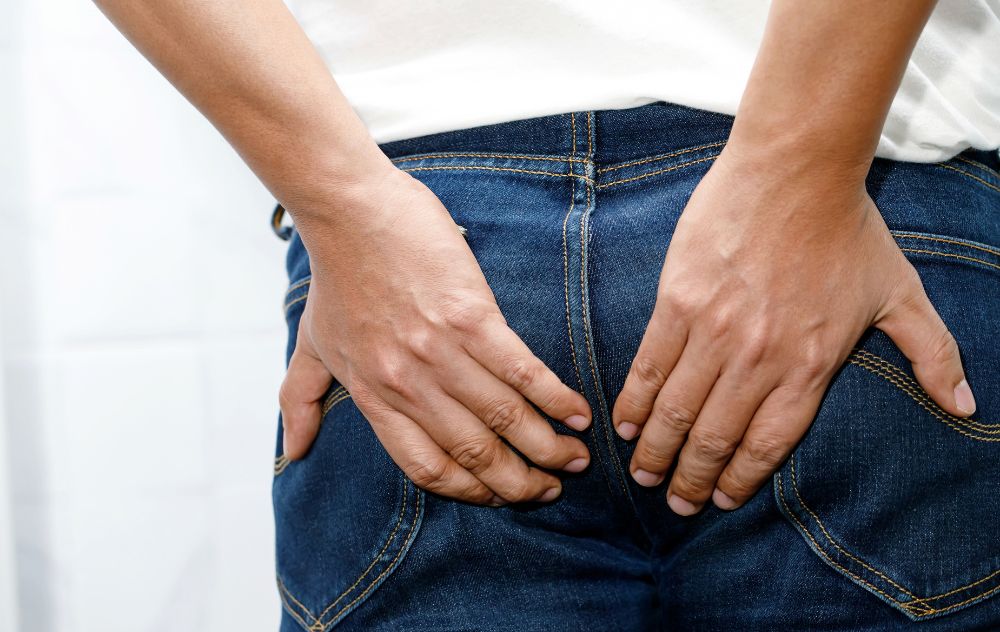
Clenching or squeezing when internal hemorrhoids are bothering you can increase pressure on the rectal veins, which may worsen swelling, discomfort, and the likelihood of hemorrhoidal tissue pushing outward. The instinct to tighten up when something hurts is natural, but with internal hemorrhoids, it often works against you. Below, we explain the mechanics behind why this happens, what squeezing actually does to hemorrhoidal tissue, and when persistent symptoms are a signal to speak with a specialist.
We will cover the pressure mechanics of clenching, how hemorrhoidal prolapse actually occurs, why the protective instinct to squeeze can backfire, and what behavioral patterns may help reduce symptom aggravation day to day to help you have a better understanding.
What Actually Happens When You Clench With Hemorrhoids
Internal hemorrhoids are enlarged vascular cushions located inside the rectum, above a boundary called the dentate line. They receive blood supply through a network of hemorrhoidal arteries and drain through hemorrhoidal veins. When the pressure in that venous network rises, the cushions engorge further.
Clenching the buttocks or the muscles around the anus raises intra-abdominal pressure. This is the same type of pressure that occurs during heavy lifting, straining during a bowel movement, or bearing down. When that pressure increases, blood has a harder time draining out of the hemorrhoidal tissue. The cushions fill with more blood, swell, and can become more irritated, tender, or prone to bleeding.
Research published in PMC confirms that patients with hemorrhoids tend to show higher resting anal pressures compared to those without hemorrhoids, and that elevated pressure is a recognized component of hemorrhoidal disease. Pelvic health clinicians also note that both conscious and unconscious clenching and butt gripping are recognized examples of increased pelvic pressure that can make hemorrhoid symptoms worse.
There are two types of clenching worth understanding:
- Reactive clenching: A short-term tightening in response to pain or discomfort. This is instinctive but may increase pressure at exactly the moment it is least helpful.
- Habitual clenching: Chronic, often unconscious tension held in the pelvic floor muscles throughout the day. This sustained pressure can contribute to ongoing hemorrhoid irritation even outside of bowel movements.
Does Squeezing Make Hemorrhoids Pop Out?
Many people picture squeezing or pushing on a hemorrhoid the way they might deal with a pimple. Internal hemorrhoids do not work that way. They are vascular tissue, not a blocked pore, and they cannot be popped to release contents and resolve.
What can happen with pressure, however, is prolapse. Internal hemorrhoids are graded on a scale from 1 to 4 based on how far they extend through the anal canal:
- Grade 1: Enlarged inside the rectum, no protrusion
- Grade 2: Protrude during a bowel movement, retract on their own
- Grade 3: Protrude with straining or exertion, require manual reduction
- Grade 4: Permanently prolapsed, cannot be reduced manually
Straining and increased intra-abdominal pressure, including from clenching, can encourage grade 2 or grade 3 hemorrhoids to prolapse at moments they otherwise might not. Clenching is not the only factor involved, but it can contribute to the downward sliding of hemorrhoidal tissue, particularly in people whose supporting connective tissue is already weakened or who have more advanced hemorrhoid symptoms.
Squeezing a hemorrhoid directly, or attempting to push it back inside forcefully, is not recommended. It can cause pain, irritate the surrounding tissue, and introduce infection risk in an area naturally exposed to bacteria. If you notice hemorrhoidal tissue protruding and it does not retract on its own, this is a signal to speak with a specialist rather than attempting to manage it manually at home.
Why the Instinct to Clench Feels Right but Doesn’t Help Hemorrhoids
When internal hemorrhoids flare, the area around the anus can feel tender, heavy, or uncomfortable. The body’s instinctive response is to guard the area by tightening the surrounding muscles. This makes sense as a protective reflex, but the anatomy of the pelvic floor means it often creates the opposite of the desired effect.
The pelvic floor is a group of muscles that forms the base of the pelvis and surrounds the rectum and anus. When these muscles are tense or held in a contracted state for extended periods, they constrict the blood vessels running through them. This constriction can slow venous drainage, keep blood pooled in the hemorrhoidal tissue, and sustain or worsen engorgement.
Pelvic health clinicians describe this as a pressure cycle: clenching raises intra-pelvic pressure, pressure impairs venous return, impaired return keeps hemorrhoids engorged, engorgement increases discomfort, and discomfort triggers more clenching. Understanding that this cycle exists is often the first step toward interrupting it.
What to Do Instead When Hemorrhoids Flare
Rather than clenching when hemorrhoids are uncomfortable, a few behavioral strategies may reduce pressure and help symptoms settle:
- Breathe through it. Deep breathing that expands the lower abdomen, rather than breath-holding or bracing, can reduce pelvic floor tension and lower intra-abdominal pressure.
- Avoid sitting on the toilet for longer than necessary. Prolonged sitting on the toilet creates a mild suction effect and pools blood downward. Go when the urge is clear, complete the movement, and leave.
- Do not strain. If a bowel movement requires significant effort, stool consistency or bowel habits may need addressing. Straining directly increases the pressure that aggravates hemorrhoids.
- Avoid prolonged sitting in general. Extended time in a seated position slows venous return. Short movement breaks can help.
- Do not attempt to push internal hemorrhoids back inside forcefully. If prolapse occurs and tissue does not retract on its own, seek evaluation.
Note: These adjustments may reduce day-to-day symptom aggravation, but they do not address the underlying vascular changes in hemorrhoidal tissue. Losing weight and hemorrhoids are also connected, as maintaining a healthy weight may help reduce pressure on the rectal veins. If symptoms are persistent or worsening, specialist evaluation is the appropriate next step.
When to See a Hemorrhoid Specialist
Behavioral adjustments can help manage hemorrhoid symptoms in the short term. They do not treat the internal hemorrhoids themselves. If any of the following apply, a specialist evaluation is the appropriate next step:
- Rectal bleeding during or after bowel movements, even if painless
- Hemorrhoid tissue protruding that does not retract on its own
- Symptoms that have persisted for more than a few weeks despite conservative care
- Discomfort or pressure that interferes with daily activities, work, or sleep
- Recurring flare-ups that keep returning after settling down
Can USA Hemorrhoid Centers Help?
At USA Hemorrhoid Centers, evaluation is performed by experienced interventional radiologists experienced in diagnosing and treating internal hemorrhoids. If symptoms are connected to grade 2 or grade 3 internal hemorrhoids, Hemorrhoid Artery Embolization (HAE) may be an appropriate option.
HAE is a minimally invasive, non-surgical outpatient procedure. A small catheter is inserted through a pinhole access point in the wrist or upper thigh and guided using imaging to the arteries supplying the hemorrhoidal tissue. Tiny particles are delivered to reduce blood flow, which causes the hemorrhoids to shrink over the following weeks. The procedure typically takes 30 to 45 minutes. Most patients return to normal activities the following day. No general anesthesia is required, and studies report clinical success rates of 93% or higher. HAE does not negatively affect anal tone, which distinguishes it from surgical alternatives that carry a risk of fecal incontinence.
Treatment option: Hemorrhoid Artery Embolization (HAE)
Clenching Cannot Treat What Is Already There.
Avoiding pressure behaviors and clenching can reduce day-to-day aggravation. They cannot reverse the vascular changes in hemorrhoidal tissue that are causing your symptoms.
If you are dealing with recurrent bleeding, prolapse, ongoing pressure, or symptoms that are interfering with your daily life, the underlying internal hemorrhoids may need direct treatment. Hemorrhoid Artery Embolization (HAE) at USA Hemorrhoid Centers is a minimally invasive, outpatient option that treats the hemorrhoidal blood supply directly, without surgery, without general anesthesia, and without a hospital stay. Most patients return to normal activities the following day.
Frequently Asked Questions
- Sun WM, et al. Anorectal physiology in hemorrhoidal disease. Cited via: Hemorrhoids: From basic pathophysiology to clinical management. PMC. https://pmc.ncbi.nlm.nih.gov/articles/PMC3342598/
- StatPearls. Internal Hemorrhoid. NIH NCBI. https://www.ncbi.nlm.nih.gov/books/NBK537182/
- Overview: Enlarged hemorrhoids. InformedHealth.org. NIH NCBI. https://www.ncbi.nlm.nih.gov/books/NBK279467/
- Bagla S, et al. Outcomes of Hemorrhoidal Artery Embolization from a Multidisciplinary Outpatient Interventional Center. J Vasc Interv Radiol. 2023. https://pubmed.ncbi.nlm.nih.gov/36736822/
- Empowered Pelvic Health. Hemorrhoids; may be easier to treat than to spell. https://www.empoweredpelvichealth.com/post/hemorrhoids-may-be-easier-to-treat-than-to-spell
Medical disclaimer: This content is for informational purposes only and does not constitute medical advice, diagnosis, or treatment. Always consult a qualified healthcare provider with any questions about a medical condition. If you are experiencing rectal bleeding, please speak with a medical professional.