
Medically reviewed by
USA Hemorrhoid Centers Review Team
Reviewed October 2026
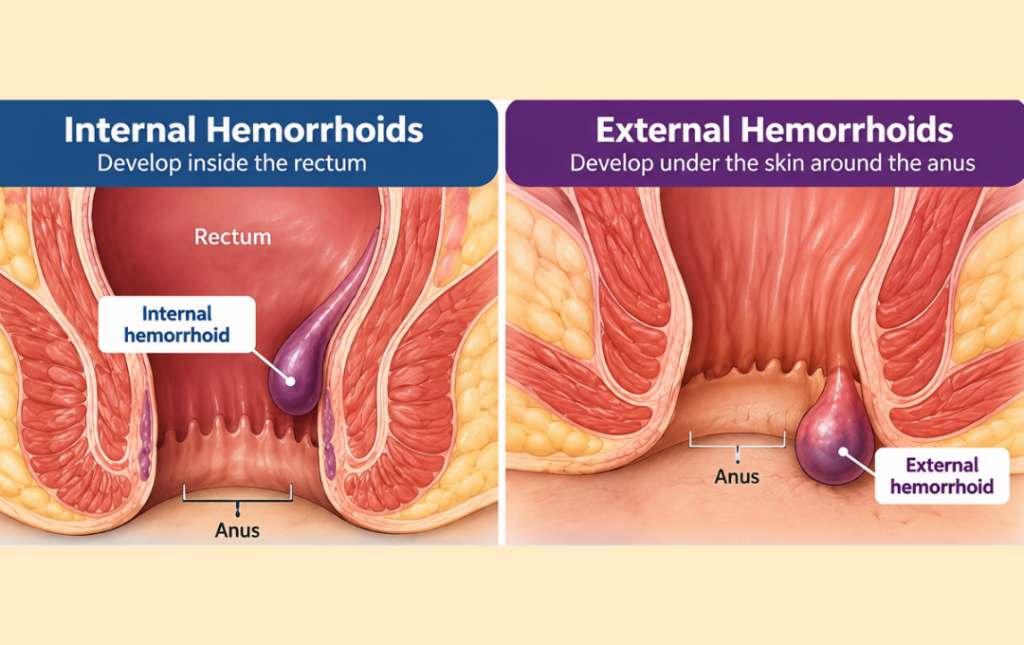
Internal and external hemorrhoids are mainly set apart by where they develop. Internal hemorrhoids form inside the lower rectum. External hemorrhoids develop under the sensitive skin around the anus. This difference in location is why symptoms can feel so different between the two types.
Straining, pregnancy, and sitting too long can trigger either one. It is also possible to have both types at the same time. Knowing these differences can help you figure out what you are dealing with, and when it is time to see a specialist.
What Are Internal and External Hemorrhoids?
Hemorrhoids are swollen blood vessels in the lower rectum and around the anus. Everyone has this tissue. It only causes problems when it swells and stretches. Doctors call a hemorrhoid “internal” or “external” based on where it sits.
The anal canal has a boundary called the dentate line. Internal hemorrhoids form above this line, inside the rectum. This area has fewer nerves, so pain is less common. External hemorrhoids form below the line, under the skin near the anus. This area has more nerves, so these hemorrhoids are more likely to hurt. Some people have both types at once. This is called a mixed hemorrhoid.1
Internal Hemorrhoid Symptoms vs. External Hemorrhoid Symptoms
Location determines how hemorrhoids feel and behave. Symptoms can be very different. It depends on whether a hemorrhoid is inside the rectum or under the skin outside it.
Internal Hemorrhoid Symptoms
Internal hemorrhoids usually do not hurt. This is because the rectum has fewer nerve endings. The most common sign is bright red blood. You may see it on toilet paper or in the toilet after a bowel movement. As internal hemorrhoids grow, they can push through the anus. This is called a prolapse. A prolapsed hemorrhoid can cause irritation, mucus, or a feeling that you still need to go.
External Hemorrhoid Symptoms
External hemorrhoids sit in skin with many more nerves. This makes them more likely to itch, swell, and hurt, especially when you sit. Sometimes a blood clot forms inside an external hemorrhoid. This is called a thrombosed hemorrhoid. It can cause sudden, sharp pain and a hard lump near the anus.
What Causes Hemorrhoids to Develop?
Internal and external hemorrhoids usually have the same causes. Extra pressure on the veins can make them swell over time. Common causes include:
- Straining on the toilet: often tied to hard or loose stools
- Pregnancy and childbirth: these add pressure to veins near the pelvis
- Sitting too long: at work, or on the toilet
- Low fiber intake: this can make stool harder to pass
- Getting older: tissue in this area weakens over time
- Family history: this may raise your own risk2
How Are Internal Hemorrhoids Diagnosed and Treated?
A hemorrhoid specialist will ask about your symptoms first. They will also ask about your bowel habits and health history. External hemorrhoids are easy to see on a simple exam. Internal hemorrhoids are harder to find. Your doctor may use a rectal exam or a small scope to get a clear view.
Mild symptoms of either type may get better with more fiber, more fluids, and less straining. If internal hemorrhoid symptoms do not improve, like ongoing bleeding or prolapse, it may be time to talk with a specialist.
USA Hemorrhoid Centers offers Hemorrhoid Artery Embolization for internal hemorrhoids. HAE is a minimally invasive, outpatient procedure. It lowers blood flow to the hemorrhoid so it can shrink over time. An experienced interventional radiologist performs HAE. It does not need general anesthesia or an overnight stay. External hemorrhoids form in different tissue, so they are treated on their own. A colorectal specialist can help if external symptoms do not improve.
When to See a Hemorrhoid Specialist
Mild symptoms often settle down on their own. Simple changes at home can help. See a hemorrhoid specialist if you notice:
- Bleeding that lasts more than a week, or keeps coming back
- A hemorrhoid that will not go back in on its own
- Pain that gets in the way of sitting or daily life
- A lump that is new or growing, or has a different look than before
Do not assume bleeding is from hemorrhoids without a checkup. Other issues can look similar. Knowing which type you have helps you and your doctor pick the right next step. That might mean HAE for internal hemorrhoids, or a referral for external hemorrhoid care.
Treatment option: internal hemorrhoid treatment
Home care can ease mild symptoms. It will not fix ongoing internal hemorrhoid symptoms.
More fiber, more water, and less straining can help day to day. But if you have bleeding, prolapse, or irritation that will not go away, home care alone may not be enough.
USA Hemorrhoid Centers offers minimally invasive, outpatient care for internal hemorrhoids. Our experienced interventional radiologists complete most procedures in the office in under an hour, with no general anesthesia needed. The first step is a consultation to talk through your symptoms and options.
Frequently Asked Questions
- National Institute of Diabetes and Digestive and Kidney Diseases (NIDDK). “Hemorrhoids.” National Institutes of Health. https://www.niddk.nih.gov/health-information/digestive-diseases/hemorrhoids
- Kim SY, et al., “Risk factors for hemorrhoidal disease among healthy young and middle-aged Korean adults,” Scientific Reports, January 7, 2022. https://www.nature.com/articles/s41598-021-03838-z
Medical disclaimer: This content is for informational purposes only and is not a substitute for professional medical advice, diagnosis, or treatment. Always seek the guidance of a qualified healthcare provider with any questions you may have regarding a medical condition.