

Medically reviewed by
Dr. Jacob White, M.D., Interventional Radiology
Reviewed August 2026
Rectal bleeding is most often caused by internal hemorrhoids, but other conditions can produce the same symptom. Whether the blood appears on toilet paper, drips into the bowl, or coats the outside of stool, rectal bleeding deserves more than a self-diagnosis.
We will cover what hemorrhoid bleeding typically looks like, which symptoms suggest something else may be involved, and when a professional evaluation can provide both clarity and relief.
What Causes Rectal Bleeding?
Rectal bleeding has a range of possible sources. Understanding the most common ones can help you recognize when symptoms align with hemorrhoids and when evaluation is especially important.
Internal Hemorrhoids and Rectal Bleeding
Internal hemorrhoids are enlarged vascular cushions located inside the rectum. Because the rectal lining in this area has limited pain-sensing nerve coverage, internal hemorrhoids frequently bleed without causing noticeable discomfort, particularly in earlier grades. When stool passes through the anal canal under pressure, it can scrape these delicate vessels, producing bright red blood.
Internal hemorrhoids are the single most common cause of lower gastrointestinal bleeding. Grade 1 and Grade 2 internal hemorrhoids may cause intermittent light bleeding, while Grade 3 and Grade 4 hemorrhoids can bleed more persistently, sometimes leading to iron-deficiency anemia over time.[1]
Rectal bleeding may appear alongside other hemorrhoid symptoms, including a sensation of pressure or fullness in the rectum, mucus discharge, or irritation after bowel movements. Learn more about hemorrhoid bleeding symptoms and what a normal episode typically involves.
Other Causes That Can Produce Similar Symptoms
Hemorrhoids are common, but they are not the only source of rectal bleeding. Several anorectal and lower gastrointestinal conditions can present with similar symptoms, which is why professional evaluation matters.
Conditions that may produce bleeding in this region include anal fissures, which are small tears in the lining of the anal canal; rectal polyps; inflammatory bowel disease; and other lower gastrointestinal conditions. The appearance of blood alone, whether bright red or darker, cannot reliably distinguish between these causes.
A hemorrhoid specialist can determine whether your symptoms are consistent with internal hemorrhoids or whether a broader evaluation is warranted.
What Hemorrhoid Bleeding Typically Looks Like
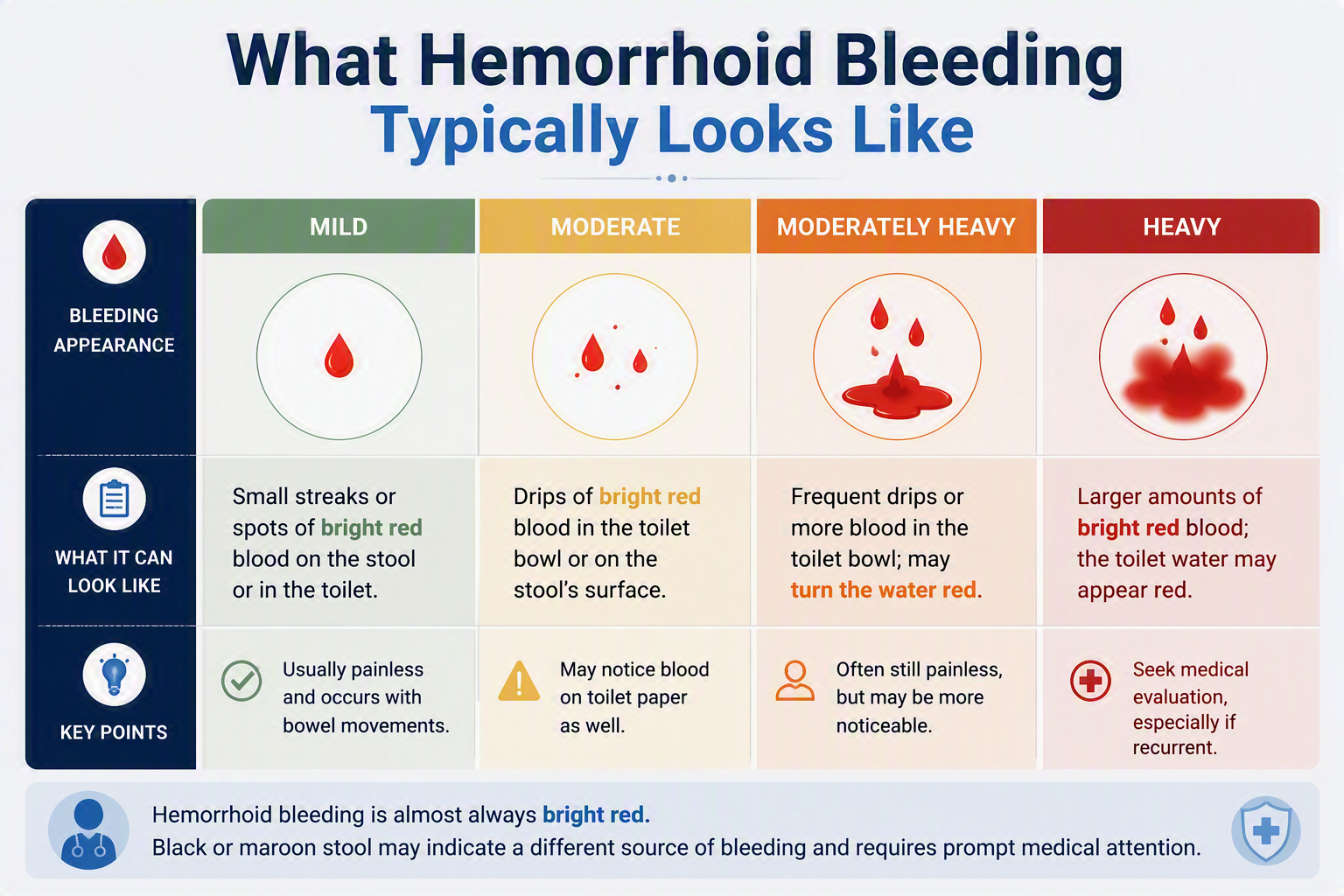
Knowing the pattern of hemorrhoid bleeding can help you recognize it, though it should not replace a professional assessment.
Bleeding from internal hemorrhoids tends to be bright red because the source is close to the anal opening, meaning the blood does not travel through the digestive system before appearing. It usually occurs during or immediately after a bowel movement. The blood typically appears on toilet paper, coats the surface of stool without mixing into it, or produces a reddish tint in the bowl.
What is not typical for simple hemorrhoid bleeding: dark or tarry stools, blood that appears mixed throughout stool rather than coating it, or bleeding that occurs without a bowel movement. These patterns suggest the source may be higher in the gastrointestinal tract and warrant prompt evaluation.
Hemorrhoid bleeding is typically painless in the case of internal hemorrhoids, because these form above the dentate line where pain receptors are sparse. Painful bleeding, by contrast, may point to an external hemorrhoid, a thrombosed hemorrhoid, or a fissure.
Understanding how much bleeding is considered normal for hemorrhoids can help frame your next steps, but any bleeding that is new, recurring, or concerning should be assessed rather than monitored indefinitely.
Symptoms That Warrant Specialist Evaluation
Rectal bleeding that fits a mild hemorrhoid pattern may improve with conservative measures like increased dietary fiber, hydration, and reduced straining during bowel movements. However, several situations call for a professional evaluation rather than continued home management.
Seek evaluation from a hemorrhoid specialist if you experience:
- Bleeding that recurs or persists beyond 7 to 10 days
- Heavy bleeding, or any bleeding accompanied by dizziness, fatigue, or shortness of breath, which may indicate blood loss affecting systemic health
- Bleeding accompanied by changes in bowel habits, unexplained weight loss, or abdominal discomfort
- A sensation of prolapsed tissue or fullness in the rectum that does not resolve
- Symptoms that have not improved after 7 to 10 days of conservative home care
Age and personal history are also relevant. Adults 45 and older, or those with a family history of colorectal conditions, should not defer evaluation of rectal bleeding.[2]
None of these symptoms guarantees a specific diagnosis. What they signal is that symptoms have moved beyond a simple, self-resolving episode and that professional assessment is the appropriate next step.
Get Directions to a Clinic Near YouWhat to Expect at a Hemorrhoid Evaluation
Many people delay care out of uncertainty about what the visit will involve. A hemorrhoid evaluation is typically brief, focused, and conducted in an outpatient setting.
During a specialist evaluation, your provider will review your symptom history, including how long bleeding has been occurring, whether it is consistent or intermittent, and whether any associated symptoms are present. A visual examination of the anal region is standard, and an anoscopy, which involves a small instrument used to view the anal canal, may be performed to assess internal hemorrhoids directly. This procedure is generally well tolerated and takes only a few minutes.
The goal of evaluation is to confirm the source of bleeding and assess the grade and condition of any hemorrhoids present. This distinguishes between hemorrhoids that may respond to conservative care and those that may benefit from a minimally invasive approach.
When to See a Hemorrhoid Specialist
When hemorrhoid symptoms are mild, temporary, and improving, conservative care is a reasonable starting point. When bleeding recurs, becomes more frequent, or does not respond to dietary and lifestyle measures, a hemorrhoid specialist is the appropriate next step.
A hemorrhoid specialist, specifically an experienced interventional radiologist, can evaluate internal hemorrhoid conditions and discuss whether options like hemorrhoid artery embolization (HAE) may be appropriate. HAE is performed on an outpatient basis, does not require general anesthesia, and focuses on reducing blood flow to the hemorrhoidal tissue.
Choosing to see a specialist does not necessarily mean choosing a procedure. The evaluation itself provides the information you need to make an informed decision about your care.
Can USA Hemorrhoid Centers Help?
At USA Hemorrhoid Centers, evaluations are performed by experienced interventional radiologists who specialize in the vascular mechanics of internal hemorrhoid conditions. If you are experiencing rectal bleeding that has not resolved, or if conservative approaches have not provided lasting relief, a consultation can help clarify next steps.
Meet Our DoctorsHemorrhoid Artery Embolization (HAE) is a minimally invasive, image-guided procedure designed for qualifying cases of internal hemorrhoids. By reducing arterial blood flow to the hemorrhoidal tissue, HAE aims to shrink the hemorrhoids and reduce recurrent bleeding. The procedure is performed outpatient, without general anesthesia, and most patients return to normal activities within a short period.
HAE is appropriate for qualifying internal hemorrhoid cases and is not used for external hemorrhoids, fissures, or other anorectal conditions. A consultation determines whether a patient is a candidate.
Treatment option: Hemorrhoid Artery Embolization
Rectal Bleeding That Persists Deserves a Specialist Evaluation
Bleeding that keeps returning is a signal that the underlying hemorrhoid condition has not been addressed. At USA Hemorrhoid Centers, experienced interventional radiologists evaluate internal hemorrhoid conditions and determine whether a minimally invasive treatment option like HAE may be appropriate for your situation.
Procedures are completed in an outpatient setting, typically in under an hour, with no general anesthesia required and a rapid return to daily activities for most patients. The first step is a consultation to evaluate your symptoms and discuss the options that fit your situation.
Frequently Asked Questions About Rectal Bleeding and Hemorrhoids
- Sun Z, Migaly J. Review of hemorrhoid disease: Presentation and management. Clin Colon Rectal Surg. 2016;29(1):22-29. doi:10.1055/s-0035-1568144
- Sabry AO, Sood T. Rectal Bleeding. [Updated 2023 Jul 31]. In: StatPearls [Internet]. Treasure Island (FL): StatPearls Publishing; 2024. https://www.ncbi.nlm.nih.gov/books/NBK537235/
- American Cancer Society. Colorectal Cancer Screening Guidelines. https://www.cancer.org/cancer/colon-rectal-cancer/detection-diagnosis-staging/acs-recommendations.html
- Practice Parameters Committee of the American College of Gastroenterology. Practice guidelines on the management of anorectal disorders. Am J Gastroenterol. 2003.
Medical disclaimer: USA Hemorrhoid Centers content provides medical education only. It is not a diagnosis or treatment recommendation. Consult a hemorrhoid specialist for evaluation.