

Medically reviewed by
USA Clinics Medical Review Team
Experienced interventional radiology specialists
Reviewed: August 2026
Hemorrhoids that persist without treatment tend to worsen over time. What begins as occasional bleeding or mild irritation can advance to more frequent discomfort, prolapse, and complications that affect daily life. Understanding how untreated internal hemorrhoids develop, and recognizing the signs that make evaluation worthwhile, can help you decide when to take action.
We will cover how hemorrhoids change over time when left unaddressed, what complications can develop at each stage, how long they can persist without care, and what minimally invasive options may be available today.
How Hemorrhoids Progress Over Time
Internal hemorrhoids are classified on a scale from Grade 1 to Grade 4 based on how much the tissue has prolapsed – meaning how far it has extended outside the rectum. Understanding the hemorrhoid grades and stages can help explain how symptoms and prolapse change as the condition progresses. Most people have Grade 1 or Grade 2 hemorrhoids before symptoms become noticeable. Without lifestyle changes or medical evaluation, the condition can advance over months or years.
Grade 1 and Grade 2: Early Symptoms
At Grade 1, internal hemorrhoids remain inside the rectum and do not protrude. The most common sign is bright red blood on toilet paper or in the bowl after a bowel movement. There is often no pain at this stage. Grade 2 hemorrhoids prolapse during straining but retract on their own afterward. Itching and mild discomfort become more noticeable.
Mild Grade 1 hemorrhoids sometimes improve with dietary changes – more fiber, more fluids, and reduced straining. In some cases, internal hemorrhoids can go away on their own when symptoms are mild and contributing factors are addressed. However, the underlying vascular tissue remains vulnerable. Without addressing contributing factors, symptoms frequently return and the condition can escalate to a higher grade.
Grade 3 and Grade 4: When Hemorrhoids Become More Serious
Grade 3 internal hemorrhoids prolapse during bowel movements and require manual repositioning – they do not retract on their own. At this stage, bleeding tends to be more frequent, discomfort during bowel movements is more pronounced, and mucus discharge or a persistent feeling of incomplete evacuation may develop.
Grade 4 internal hemorrhoids are permanently prolapsed and cannot be manually repositioned. They represent the most advanced stage of internal hemorrhoidal disease and carry the highest risk of complications, including thrombosis, strangulation, and chronic blood loss. Medical evaluation at this stage is important.
Complications That Can Develop

When hemorrhoids persist for months or years without treatment, several complications can develop. These are not inevitable, but the risk increases as the condition advances in grade and duration.
Chronic Bleeding and Anemia
The most common symptom of internal hemorrhoids is rectal bleeding during bowel movements. Over time, this blood loss can become more frequent and more significant. Chronic bleeding may lead to iron deficiency anemia, which causes fatigue, weakness, dizziness, and pale skin.[1] If you are noticing blood regularly during bowel movements and have been feeling unusually tired, it is worth discussing this pattern with a specialist.
Prolapse and Thrombosis
As internal hemorrhoids advance in grade, prolapse becomes more severe and harder to manage. A prolapsed hemorrhoid that goes unevaluated can develop a blood clot inside it – a condition called a thrombosed hemorrhoid. Thrombosis causes sudden, intense pain and significant swelling. A thrombosed hemorrhoid that loses its blood supply may also become strangulated, a more urgent complication that requires prompt evaluation.[2]
Infection and Tissue Damage
Hemorrhoidal tissue that is persistently prolapsed or irritated becomes more vulnerable to infection. Bacteria can enter through small sores or fissures that develop in the area. An is a condition that can develop alongside chronic hemorrhoid irritation. Infections associated with long-standing hemorrhoids may require antibiotic treatment and specialist evaluation.
How Long Can Hemorrhoids Last Without Treatment?
Mild Grade 1 hemorrhoids may improve within a few days with dietary adjustments. Moderate to severe hemorrhoids can persist for weeks, months, or years if left unaddressed. Once hemorrhoidal tissue has advanced beyond Grade 1, it rarely resolves without some form of medical evaluation.
The duration also depends on the underlying causes. If contributing factors like chronic constipation, prolonged sitting, or straining continue without change, existing hemorrhoids are unlikely to improve and may continue to worsen. Hemorrhoids account for more than 3.3 million ambulatory care visits in the United States each year – a reflection of how commonly symptoms persist longer than people expect.[3]
Can You Live With Hemorrhoids Without Treatment?
Some people manage mild hemorrhoid symptoms for years without seeking treatment. Lifestyle changes including increased fiber intake, adequate hydration, and reduced straining can help keep early-stage hemorrhoids manageable. However, living with untreated hemorrhoids at more advanced stages carries real tradeoffs.
Beyond the physical symptoms, hemorrhoids that persist long-term can affect daily comfort in ways that add up: difficulty sitting for extended periods, disrupted routines, and the low-grade anxiety of recurring flare-ups. Chronic bleeding, even in small amounts, may gradually contribute to iron deficiency anemia. And at higher grades, the risk of acute complications – thrombosis, strangulation, permanently prolapsed tissue – increases meaningfully.
It is worth knowing that hemorrhoid symptoms are not something you need to manage indefinitely on your own. A specialist evaluation can clarify the grade and severity of your condition, identify what is contributing to it, and outline whether a minimally invasive option may be appropriate for your situation.
When to See a Hemorrhoid Specialist
If you have been experiencing any of the following, a consultation with a hemorrhoid specialist is the appropriate next step:
- Rectal bleeding that has continued for more than one to two weeks
- Hemorrhoid symptoms that have not improved with lifestyle changes
- Prolapse that requires manual repositioning, or tissue that cannot be repositioned at all
- Sudden severe pain or significant swelling near the anus
- Fatigue, dizziness, or pale skin alongside rectal bleeding
- Recurring flare-ups that are becoming more frequent or intense
Note: Any rectal bleeding should be evaluated by a clinician to rule out other causes. Hemorrhoids are among the most common explanations for bright red rectal bleeding, but a specialist can confirm the source and rule out other conditions.
Can USA Hemorrhoid Centers Help?
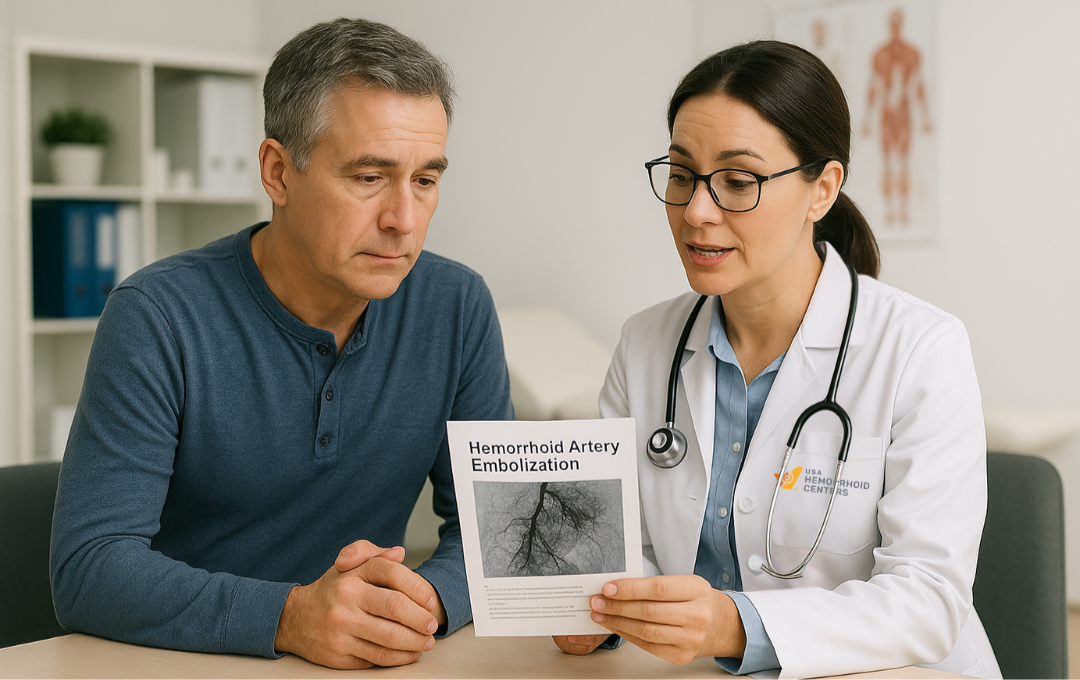
USA Hemorrhoid Centers specializes in the evaluation and non-surgical treatment of internal hemorrhoids. Our experienced interventional radiologists offer Hemorrhoid Artery Embolization (HAE) – a minimally invasive, outpatient procedure that reduces blood flow to the hemorrhoidal tissue, causing it to shrink and symptoms to improve over time.
HAE requires no incisions, no general anesthesia, and no hospital stay. The procedure is typically completed in under an hour, and patients can return to normal activities quickly. A specialist will evaluate your hemorrhoid grade and symptoms before recommending the most appropriate approach for your individual situation.
If symptoms have persisted for more than a few weeks, have worsened over time, or are interfering with daily life, an evaluation is the right next step.
Treatment option: hemorrhoid treatment
Hemorrhoids Rarely Improve on Their Own Once Symptoms Persist
Lifestyle changes can help manage mild symptoms, but if you are experiencing recurring bleeding, prolapse, or ongoing discomfort, those adjustments alone are unlikely to resolve the underlying condition. These are clinical signs that the hemorrhoidal tissue has progressed and warrants evaluation.
USA Hemorrhoid Centers offers minimally invasive, outpatient treatment performed by experienced interventional radiologists. Procedures are completed in the office, typically in under an hour, with no general anesthesia required and a rapid return to daily activities for most patients. The first step is a consultation to evaluate your symptoms and discuss the options that fit your situation.
Frequently Asked Questions About Untreated Hemorrhoids
- Wu EB, Sung FC, Lin CL, Wu KL, Chen KB. “Colorectal Cancer Risk in Patients with Hemorrhoids: A 10-Year Population-Based Retrospective Cohort Study.” International Journal of Environmental Research and Public Health. 2021;18(16):8655. pubmed.ncbi.nlm.nih.gov/34444382/
- Aurora Health Care. “Hemorrhoid Symptoms and Treatment.” aurorahealthcare.org/services/gastroenterology-colorectal-surgery/hemorrhoid-treatment
- National Institute of Diabetes and Digestive and Kidney Diseases. “Hemorrhoids.” niddk.nih.gov/health-information/digestive-diseases/hemorrhoids
Medical disclaimer: This content is for informational purposes only and is not a substitute for professional medical advice, diagnosis, or treatment. Always seek the guidance of a qualified healthcare provider with any questions you may have regarding a medical condition.